We’ve spent years talking about “21st-century skills,” the 4Cs, and soft skills. The language has shifted again, this time to durable skills.
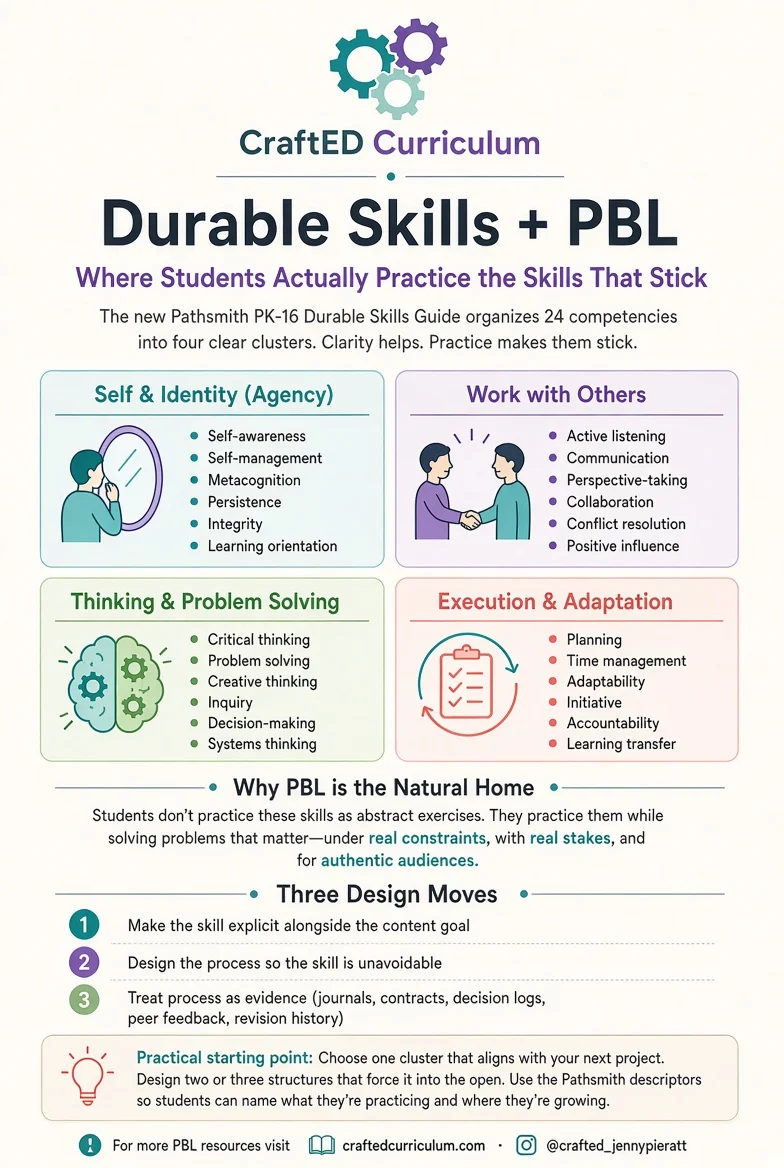
The new Pathsmith PK-16 Durable Skills Development & Application Guide from America Succeeds organizes these competencies into four clear clusters:
- Self & Identity (what I labeled Agency): Self-awareness, self-management, metacognition, persistence, integrity, learning orientation
- Work with Others: Active listening, communication, perspective-taking, collaboration, conflict resolution, positive influence
- Thinking & Problem Solving: Critical thinking, problem solving, creative thinking, inquiry, decision-making, systems thinking
- Execution & Adaptation: Planning, time management, adaptability, initiative, accountability, learning transfer
These aren’t new ideas. What’s new is how explicit and developmentally mapped the descriptors are. That clarity is useful for teachers, for students, and for the conversations we have with families.
But clarity alone doesn’t develop the skills.
The question that matters is: Where do students actually get to practice them in a way that sticks?
Why PBL is the natural home for durable skills
You can teach these skills through isolated lessons and activities. Many schools do.
PBL offers something more powerful: a realistic container.
In a well-designed project, students don’t practice collaboration as an abstract exercise. They practice it while trying to solve a problem that matters, under real constraints, with real stakes, and with an authentic audience. The same is true for self-management, systems thinking, initiative, and the rest.
PBL has always claimed to develop these competencies. The difference now is that we have clearer language and developmental progressions to make the work more intentional, and more visible.
Three design moves make the difference:
- Make the skill explicit alongside the content goal
At the start of a project, name both.
“We’re learning about watershed systems and we’re developing systems thinking and collaboration.”
When the language is shared, students can notice their own growth. Parents can see it too. - Design the process so the skill is unavoidable
If you want students to practice conflict resolution, the project structure has to create moments where conflict is likely and productive.
If you want initiative and accountability, the project needs real decision points that students own, not just tasks they complete. - Treat process as evidence
PBL’s emphasis on process over product is one of its quiet strengths. Reflection journals, team contracts, decision logs, peer feedback protocols, and revision history all become evidence of durable skill growth. The final product still matters, but it is no longer the only thing that counts.
A practical starting point
You don’t need to assess all 24 skills at once.
Choose one cluster that aligns with the natural demands of your next project. Design two or three structures that force that cluster into the open. Then use the Pathsmith descriptors to help students name what they’re practicing and where they’re growing.
That’s how durable skills stop being a poster on the wall and start becoming part of how students learn to work, think, and show up.
About the Author: Jenny
