
Project Spotlight as Featured in Preparing Future Teachers for AI interview with Pathways Alliance. Below is the step-by-step process I used with AI for the launch of my project “Pop-Up Power: From Pumpkin Patch to Winter Market”. I have copy and pasted the results exactly as it was produced from Grok. Note: This process took a total of 13 minutes to create.
**Project Title:** Pop-Up Power: From Pumpkin Patch to Winter Market
**Driving Question:** How can we design a successful, temporary pop-up business for our school’s Winter Market by studying real seasonal businesses and applying the key principles of the pop-up model?
**Grade Level:** Middle School (Entrepreneurship)
**Duration:** October (approximately 4 weeks / 16–20 class periods, adjustable to your schedule)
**Culminating Product:** A complete team business plan + pitch for a student-run Winter Market pop-up shop that could actually operate at school later in the year.
### Learning Goals
Students will be able to:
– Explain the core features of a pop-up business model (temporary, location-driven, low fixed costs, high experiential value, seasonal timing).
– Analyze real seasonal businesses (pumpkin patch and Christmas tree farm) for customer experience, revenue streams, costs, marketing, and operations.
– Apply design thinking and entrepreneurial skills to create a viable business plan for a school Winter Market pop-up.
– Collaborate, give/receive constructive critique, and present professionally.
Project Overview Structure (PBL Elements)-
**Entry Event:** Short video montage + mystery “What makes this temporary business succeed?” challenge using photos of pumpkin patches and holiday markets.
– **Inquiry & Research:** Guided analysis of real businesses + field experiences.
– **Student Voice & Choice:** Teams choose their own Winter Market product/concept (hot cocoa stand, handmade ornaments, gift wrapping service, photo booth, etc.) within school-appropriate guidelines.
– **Critique & Revision:** Peer feedback galleries and teacher conferences.
– **Public Product:** Formal business plan packet + 3–5 minute pitch to a panel (teachers, administrators, or local entrepreneurs).

Month-of-October Timeline
**Week 1: Understanding the Pop-Up Model (Building Knowledge)**
Focus: What is a pop-up and why do they work?
– Day 1–2: Entry event + define “pop-up.” Mini-lessons and discussion on characteristics (temporary footprint, experiential marketing, low overhead, scarcity/urgency, location leverage). Compare traditional store vs. pop-up.
– Day 3: Case studies (short videos/articles of successful pop-ups: holiday markets, food trucks, seasonal retail). Students complete a “Pop-Up Scorecard” identifying strengths and risks.
– Day 4: Introduce the final challenge and team formation (3–4 students). Teams begin brainstorming possible Winter Market concepts and draft a simple “Need-to-Know” list.
– Formative check: Exit tickets or quick team concept statements.
**Week 2: Pumpkin Patch Field Experience & Analysis**
Focus: Observe a live seasonal business in action.
– Pre-trip (1–2 class periods): Prepare observation tools — customer journey map template, cost/revenue speculation sheet, experience audit (atmosphere, signage, pricing, add-ons, staff interaction, photo opportunities, etc.). Review safety and etiquette.
– Field Trip: Visit a local pumpkin patch (ideally mid-to-late October when activity is high). Students collect photos (with permission), notes, interviews with workers/owners if possible, and complete on-site observation forms.
– Post-trip (2 class periods): Debrief in teams. Create visual analysis posters or digital slides covering:
– Target customers and experience design
– Multiple revenue streams (admission, pumpkins, food, photos, games, merchandise)
– Temporary setup advantages and challenges
– Lessons transferable to a school Winter Market
– Homework/extension: Individual reflection journal entry comparing personal expectations vs. reality.
**Week 3: Christmas Tree Farm Insights + Ideation**
Focus: Transfer learning to a second seasonal model and begin designing their own.
– Research or second visit (adjust based on local availability): Many Christmas tree farms open late October or have fall events; if a physical visit is not feasible, use virtual tours, owner interviews (Zoom), website/menu analysis, or curated video packages. Students apply the same observation tools used at the pumpkin patch.
– Side-by-side comparison activity: Venn diagram or matrix of pumpkin patch vs. Christmas tree farm (timing, perishability, customer emotions, add-on sales, staffing, risk).
– Ideation sprint: Teams narrow to one Winter Market concept. Use design-thinking steps (empathize with school community, define the problem/opportunity, ideate solutions, rapid prototype of concept).
– Begin business plan skeleton: Mission/vision, target customer, unique value proposition, product/service description, basic pricing ideas.
– Formative: Teacher check-ins + peer “gallery walk” of early concepts with sticky-note feedback.
**Week 4: Business Plan Development, Critique & Pitch Prep**
Focus: Turn analysis into a professional plan and prepare to present.
– Deep work days: Teams complete full business plan sections using a provided template (recommended sections below).
– Mini-lessons as needed: Simple financial projections (startup costs, pricing, break-even), marketing (social media, school announcements, scarcity tactics), operations (setup, staffing, inventory, safety), risk assessment.
– Critique & revision: Structured peer review protocol + teacher conferences. Students revise based on feedback.
– Pitch practice: Rehearse 3–5 minute pitches with visual aids (poster, slides, or prototype of product/signage).
– Culminating presentations: Teams present to a panel. Audience feedback forms + celebration of learning.
– Reflection: Individual and team written reflections on what was learned about entrepreneurship, teamwork, and the pop-up model. Connect to possible real implementation at the actual Winter Market.
### Recommended Business Plan Template Sections (Middle-School Friendly)
1. Concept & Unique Value Proposition
2. Target Customers & Customer Experience
3. Products/Services & Pricing
4. Marketing & Promotion Plan (including how to create buzz and urgency)
5. Operations (location at school, setup/teardown, staffing, materials)
6. Simple Financials (startup costs, projected sales, profit goal)
7. Risks & Contingencies
8. What We Learned from Real Pop-Ups
Assessment
– Formative: Observation tools, journals, team check-ins, peer feedback quality.
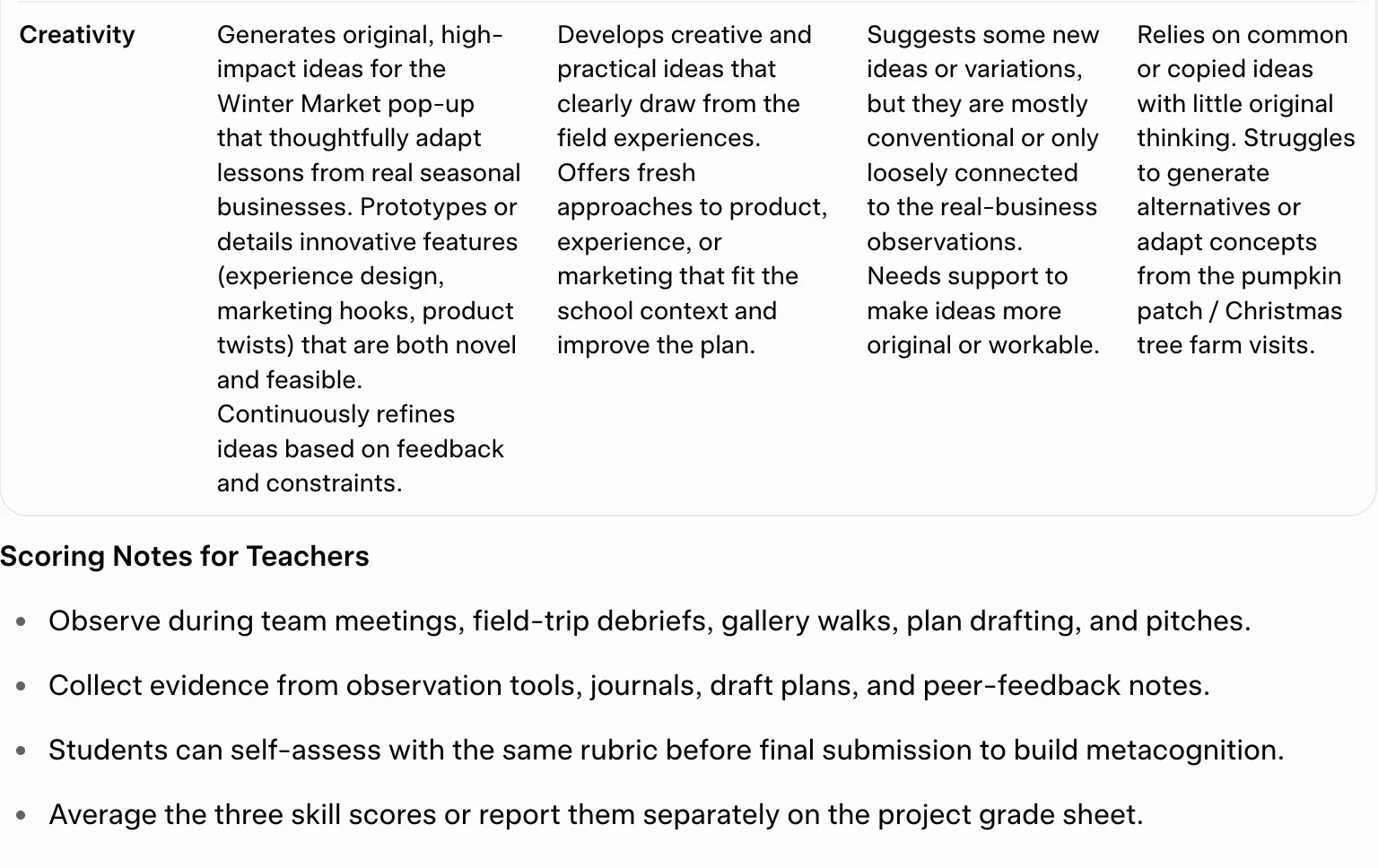
– Summative: Business plan rubric (clarity, feasibility, application of pop-up principles, financial reasonableness, creativity) + pitch rubric (content, delivery, visuals, response to questions).
– Soft skills: Collaboration, communication, and reflection rubrics or checklists.

### Teacher Tips for Success
– Secure field trip permissions and funding early; have a strong virtual backup for the Christmas tree farm portion.
– Partner with the school’s Winter Market organizers so student plans have a realistic pathway to implementation.
– Provide scaffolds (templates, sentence starters, example plans) while still leaving room for creativity.
– Emphasize that failure is data — encourage teams to revise based on feedback rather than aiming for perfection on the first try.
– Celebrate publicly: Display plans in the hallway or feature winning ideas in the school newsletter.
This plan keeps the authentic “learn from real seasonal businesses → apply to our own temporary school venture” arc while fitting cleanly into October’s calendar and energy. It builds transferable entrepreneurial skills and gives students a meaningful public product they can feel proud of.



**Weekly Reflection Prompts**
*(Middle School Entrepreneurship – Pop-Up Power Project)*
Use these as short journal entries, Google Form responses, or end-of-week exit tickets (5–8 minutes). Ask students to write in complete thoughts and include specific evidence. Review them weekly so you can follow up with individuals or small groups.
### Week 1: Understanding the Pop-Up Model
1. This week I learned that I am the kind of learner who… (Describe one strength or habit you noticed in yourself while exploring pop-up businesses.)
2. Evidence: One specific moment, discussion, or piece of work that shows this is…
3. One question I still have or one thing that felt challenging for me as a learner is…
4. Something I would like my teacher to know or help me with next week is…
### Week 2: Pumpkin Patch Field Experience & Analysis
1. During the pumpkin patch visit and analysis, I noticed that I learn best when… (Think about observing, taking notes, talking with teammates, or making sense of what you saw.)
2. Evidence: A specific observation, note, or team conversation that proves this is…
3. One way I contributed to my team’s understanding (or one way I held back) was…
4. Something I want my teacher to notice or support me with is…
### Week 3: Christmas Tree Farm Insights + Ideation
1. While comparing businesses and generating ideas for our Winter Market pop-up, I realized that as a thinker I… (Are you someone who connects ideas quickly, needs time to process, likes to question, or prefers to build on others’ thoughts?)
2. Evidence from my notes, sketches, or team discussions that shows this is…
3. One idea or decision I feel proud of (or one that still feels stuck) is… because…
4. A question or concern I have for my teacher about my learning or my team is…
### Week 4: Business Plan Development, Critique & Pitch Prep
1. Looking back over the whole project, the biggest way I have grown as a learner is…
2. Evidence: Two specific examples from my work, feedback I gave/received, or moments in the pitch process that show this growth are…
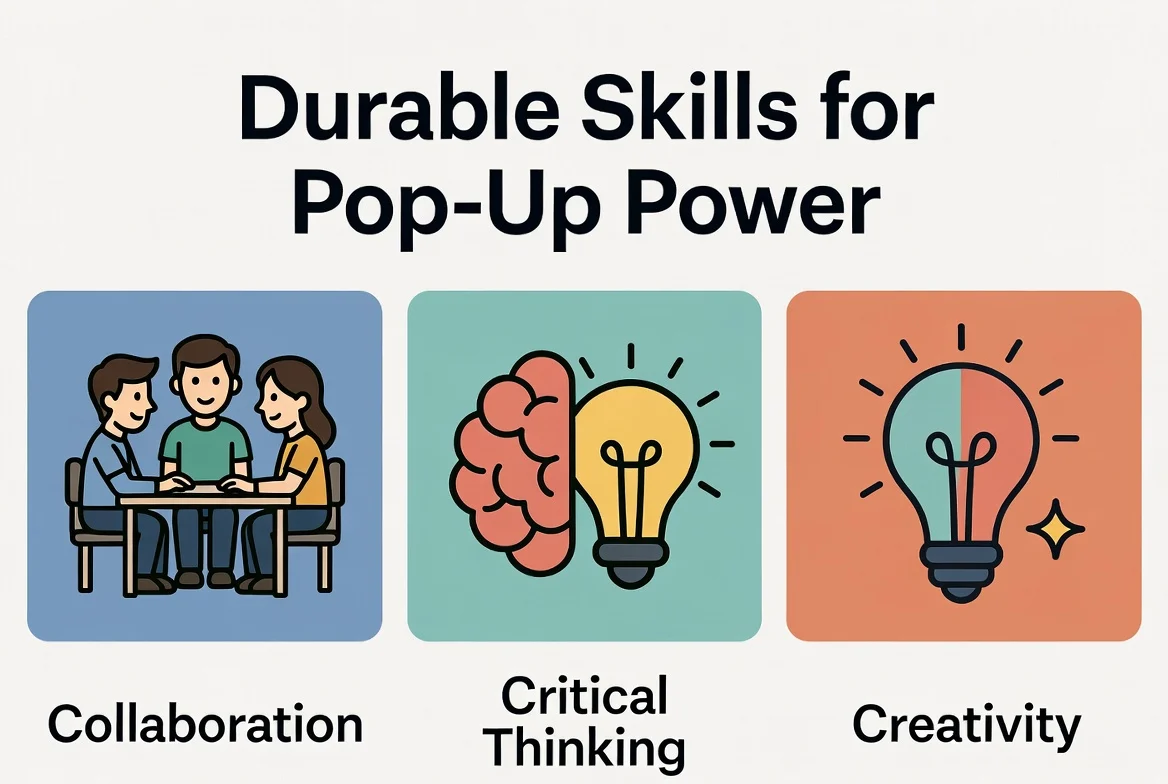
3. One durable skill (collaboration, critical thinking, or creativity) I want to keep practicing is… because…
4. One piece of feedback or support I would still like from my teacher before we finish is…
**Teacher Tip:**
After reading the responses, highlight or reply to one sentence per student with a short follow-up question or encouragement (sticky note, private comment, or quick conference). This turns the reflections into genuine two-way conversations and helps you catch emerging needs early.

*If I’m happy with the results then I ask Grok to save the ideas as a PDF that I can download or print for my students. Click here to see what Grok and I created as a starting point: Winter_Market_PopUp_Business_Plan_Template
About the Author: Jenny
