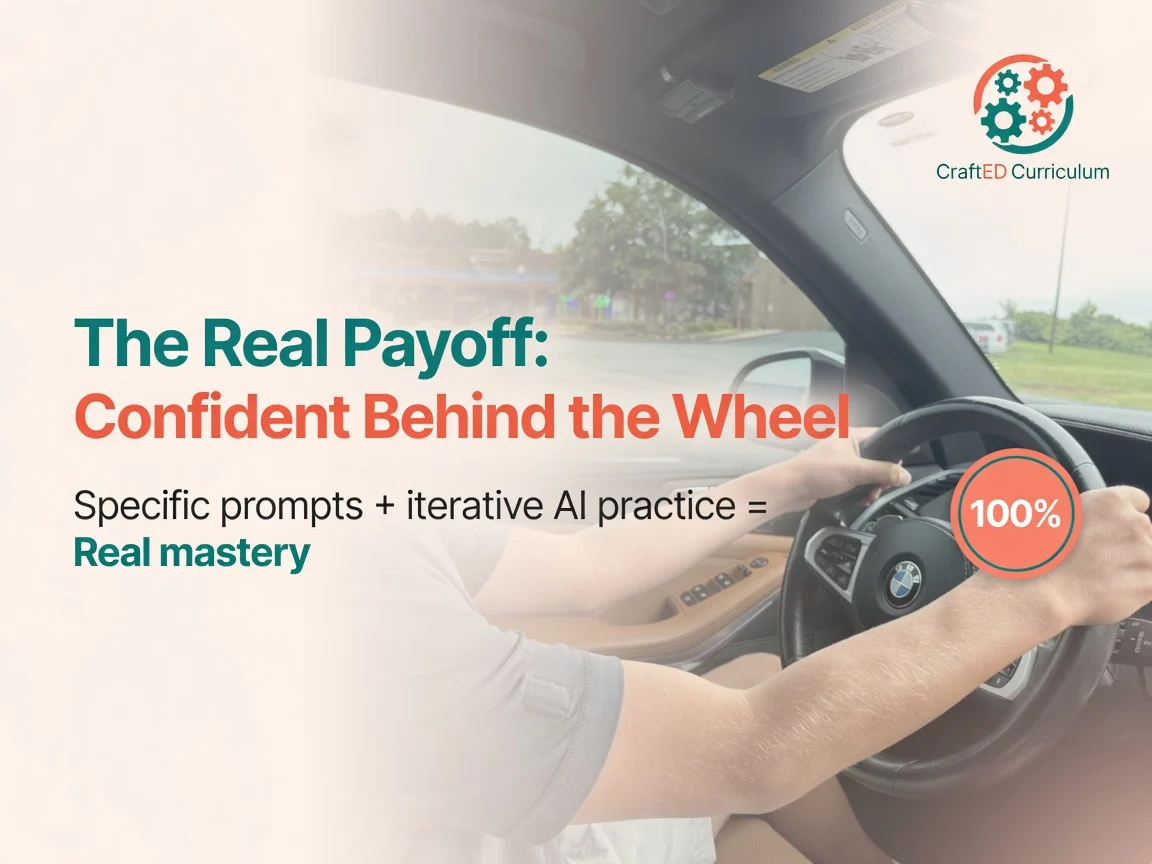
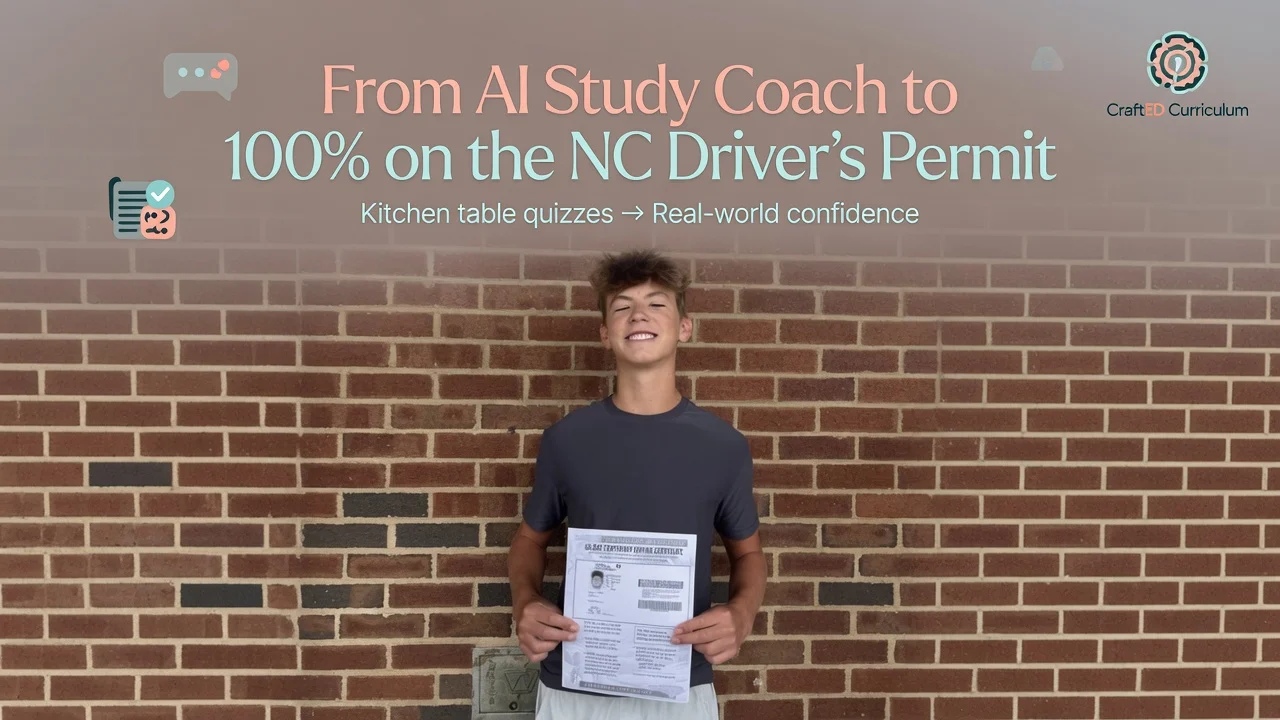
PBL 101 starts with a simple truth: the best learning experiences are specific, iterative, and human-centered. Last week I saw that truth play out at our kitchen table in a way that has direct implications for every teacher designing PBL curriculum. My son was preparing for his North Carolina driver’s permit test. A few days later he walked in with a perfect 100%. When we asked what he did differently, he said:
“I did what you told me, Mom. I typed something really specific: ‘I need help studying for my NC driver’s permit test.’
It gave me a quiz and I missed 7. Then it coached me on exactly what I missed. Another quiz I missed 5. By the last two quizzes I was getting 100 every time. And it was so nice and excited for me!”
What he described is the essence of effective AI tools for teachers:
clear prompting + iterative practice + encouraging feedback.
This is not advanced AI wizardry. It is how to use AI in the classroom in a way that actually supports student learning, and it maps beautifully onto strong PBL curriculum design.
Why This Matters for PBL 101 and Classroom Practice
In traditional PBL 101 training, we emphasize driving questions, sustained inquiry, and student agency. The same principles apply when we introduce AI:
- Specificity: Vague prompts produce vague results. Clear context (just like a well-written driving question) gives AI the information it needs to be useful.
- Iteration: One quiz or one draft is never enough. The power of AI tools for lesson planning and student practice lies in the feedback loop.
- Tone and Support: Students respond to encouragement. AI literacy for teachers includes knowing how to prompt for a supportive, coaching voice.
These three elements turn generic AI tools for education into practical classroom assets.
Practical AI Resources for Teachers: NotebookLM Prompt Examples
One of the most accessible AI tools for teachers right now is NotebookLM. Because it works from your uploaded materials, it stays grounded in your curriculum rather than pulling random internet content.
Here are classroom-ready prompts you can adapt for any unit:
Study Guide Generation
“Create a clear, student-friendly study guide from the uploaded sources on [topic]. Include key concepts, definitions, examples, and two versions: one concise and one with more explanation.”
Practice Quizzes
“Generate a 10-question multiple-choice quiz based on the uploaded materials. Include an answer key with explanations for each question.”
Targeted Coaching
“A student missed questions on [topics]. Act as a supportive tutor: explain the concepts simply, give examples, then create a new focused quiz.”
Differentiation
“Create a beginner version with more scaffolding and an advanced version with application questions for [topic].”
Full Coaching Session
“Serve as a study coach. Start with a diagnostic quiz, review missed items with explanations, then continue with follow-up quizzes until the student reaches 90% or higher. Be encouraging and celebrate progress.”
These prompts give teachers a concrete way to use AI in the classroom without becoming AI experts overnight. They also support the kind of differentiated practice that strong PBL curriculum requires.
Connecting AI Tools to Project-Based Learning
When we talk about AI tools for lesson planning or AI literacy for teachers, the goal is never to replace the teacher. The goal is to amplify the coaching and feedback that are hard to scale in a busy classroom.
In a Project-Based Learning unit, students can use these same strategies to:
- Build background knowledge before launching into a project
- Iterate on research or product drafts
- Receive targeted support on content while the teacher focuses on deeper facilitation
Looking Ahead
My son didn’t just pass a test. He practiced a transferable skill: learning how to learn with AI as a patient coach. That skill will serve him far beyond the DMV.
The same opportunity exists in every classroom. When we approach AI in schools with clarity and intention, we give teachers better tools and students better support.
Ready to go deeper?
If you want ready-to-use NotebookLM workflows, prompt templates, and classroom strategies that connect AI tools for teachers directly to PBL curriculum, I’ve built them into my new AI + PBL E-Course. The course is designed for educators who want practical ways to use AI while keeping the human relationships at the center of learning.
→ Explore the AI + PBL E-Course
*Disclosure: This post was developed with AI as a collaborative thought partner. All insights and experiences are my own, drawn from over 20 years of classroom teaching and educational coaching in Project-Based Learning.
About the Author: Jenny
