Artificial intelligence in education is no longer a future topic, it is already reshaping classrooms. Teachers are asking practical questions: How do I use AI tools for teachers effectively? How can ChatGPT for teachers support (rather than replace) strong pedagogy? And how do we keep project-based learning human-centered in an AI world?
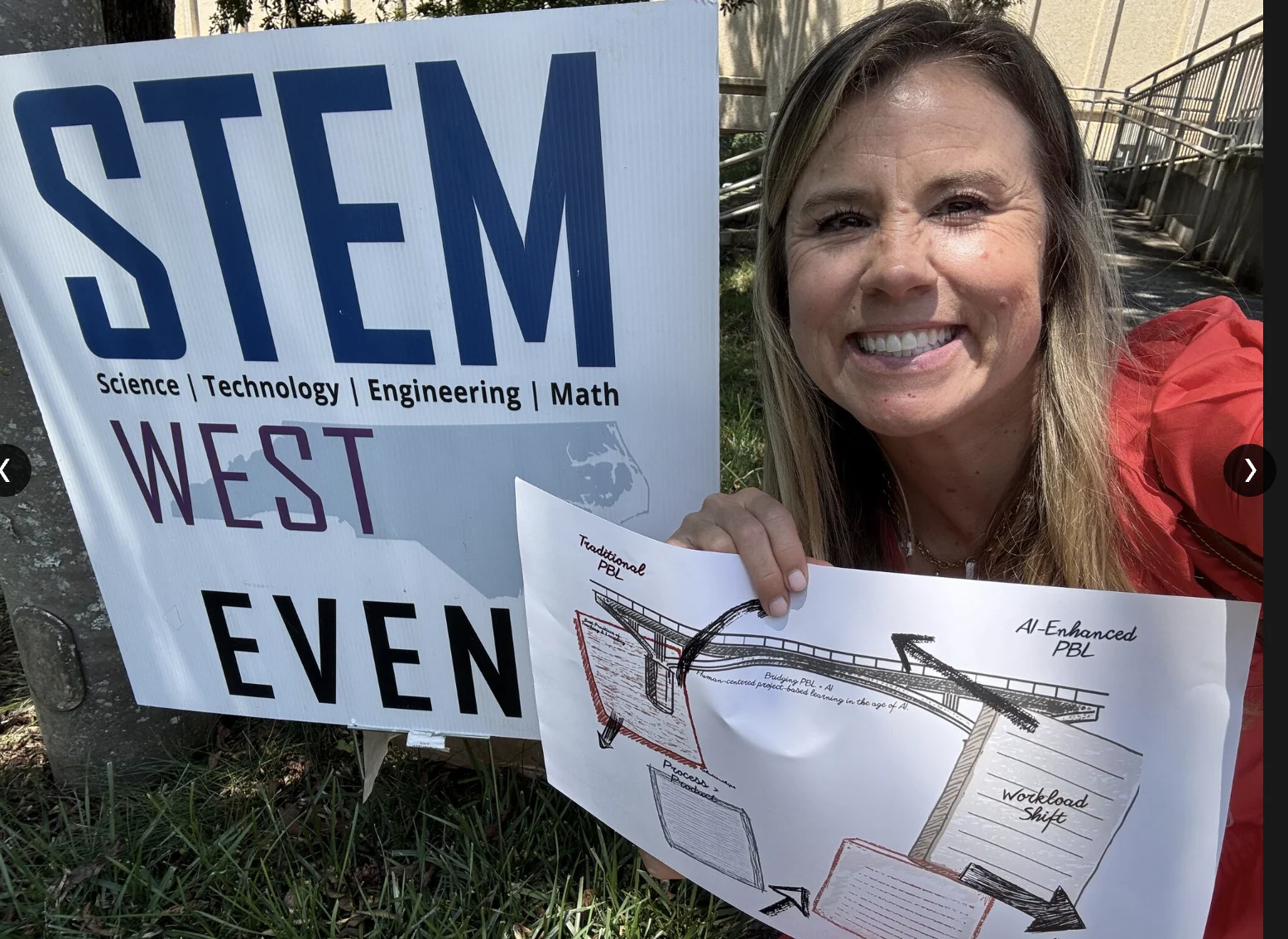
At STEM West’s AI Educators Day, I shared a clear framework for answering those questions.
The Teacher Identity Shift
We have moved through three stages:
- Sage on the Stage: information gatekeeper
- Guide on the Side: facilitator and co-learner
- The Orchestrator: human-in-the-loop mentor who designs conditions for learning and uses AI as a thought partner
This shift is especially important in AI in the classroom and AI in schools contexts, where the temptation is to let tools take over content creation.
Why Relationships Still Matter Most
- PBL pedagogy builds collegial classroom environments
- Those environments foster positive teacher-student relationships
- Relationships unlock personalized instruction and deep engagement
AI tools for education can accelerate planning and differentiation. They cannot replace the relational foundation of student success.
Making Project-Based Learning Sustainable
Traditional secondary PBL often collapses under teacher bandwidth: heavy material creation, constant scaffolding, and grading multiple drafts.
When AI is used intentionally as a co-pilot (not autopilot), the workload shifts. Teachers spend less time generating materials and more time mentoring, facilitating group dynamics, and assessing process. Instant differentiation becomes possible, and assessment can focus on durable skills rather than polished products alone.
A Practical Human-in-the-Loop Workflow for AI in Project-Based Learning
- Teacher defines key standards and durable skills.
- AI brainstorms authentic project ideas. Try this prompt: “Generate 5 authentic, real-world PBL project ideas connected to [topic] that require human collaboration and critical thinking.”
- Teacher selects, refines, and contextualizes for the local community.
- AI helps scaffold learning tasks while the teacher retains final creative control.
Designing AI-Resistant Driving Questions
Strong driving questions cannot be fully answered by AI in one prompt.
Example: Instead of “What are the causes of the Israeli-Palestinian conflict?” Try: “How can we, as local student advocates, design a community exhibition that captures multiple narratives of the Israeli-Palestinian conflict to foster empathy in our school?”
Useful prompt for teachers: “You are a PBL Coach. Help me craft a compelling, open-ended driving question for a PBL unit on [topic] for [grade] that cannot be fully answered by AI in one prompt.”
Assessment in the Age of AI
If AI can generate a polished essay in seconds, assessments must value what remains uniquely human:
- Critical thinking
- Empathy and perspective-taking
- Creativity and iteration
- Ethical reasoning
- Complex collaboration
AI tools for lesson planning and rubric design can accelerate the creation of formative check-ins and product options. Final evaluation of student process, however, stays with the teacher.
Guardrails for Human-Centered, AI-Enhanced Learning
- Process and durable skills matter more than polished digital output.
- Projects remain open-ended and meaningful to the community.
- The teacher is always the final decision-maker.
- AI is a thought partner, never the author.
Final Thought
Artificial intelligence in education and AI tools for teachers can remove much of the heavy lifting in project design and differentiation. That creates space for the work only teachers can do: connect, mentor, and inspire.
If you are looking for practical ways to integrate AI into project-based learning while protecting what is most human about teaching, this is the path forward.
About the Author: Jenny
