Holidays give teachers a built-in audience, a real deadline, and a reason students already care. These five projects use that window to teach business thinking. Students study real companies, design for real people, and in several cases sell or pitch to a real audience.
The holiday is the deadline and the audience. The learning is the business.
PBL Holiday Idea 1- Winter Market Pop-Up: A Middle School Entrepreneurship Project
Students study how a seasonal business works, then build one of their own. We used the pumpkin patch as the model, then applied that same structure to a winter market.
Grade level: Grades 6–8
Driving Question: How can we design, produce, and sell a product that belongs at a winter market and works for our school community?
Project Overview: Students analyze real winter-market products, look for patterns in audience, price, uniqueness, and feasibility, then plan and run their own stalls. The packet walks them from research to a teacher-approved business plan before anyone starts making.
Subjects: Entrepreneurship, math, ELA, design.
Skills:
- Market research: reading real product listings and local vendor lists
- Comparative analysis of audience, price, uniqueness, and seasonal fit
- Unit cost, selling price, and profit per item
- Production planning: materials, quantity, and time per item
- Branding, booth design, and a short sales pitch
- Collaboration through team roles: production, marketing, sales, money handling
- Reflection and peer feedback
Optional AI Integration:
- Teachers: Use AI to draft product-analysis prompts or a research guide of seasonal categories, then edit for your local market.
- Students: AI can suggest product names or booth copy. Students still price from real costs and revise the pitch after peer feedback.
Milestones & Scaffolding:
- Analyze successful products.
- Synthesize patterns and brainstorm without filtering.
- Develop a top idea with cost, price, and profit per item.
- Complete the business plan and get teacher approval.
- Produce and sell at the school winter market.
- Reflect on what the examples changed.
Final Products & Exhibition: A completed entrepreneur’s guide and business plan, a finished product, and a stall at a school winter market.
Assessment & Reflection: Rubric on research quality, realistic pricing, and the plan, plus market-day process. Peer feedback covers strengths, suggestions, and questions.
Teacher Tips & Differentiation: A research guide with real categories and typical student price ranges (1–3 stickers and cookies, 3–5 keychains and lip balm, 5–10 candles and small gift sets) keeps ideas feasible. Cap materials cost. Sixth graders can work from a shorter product list. Eighth graders can own the full cost sheet.
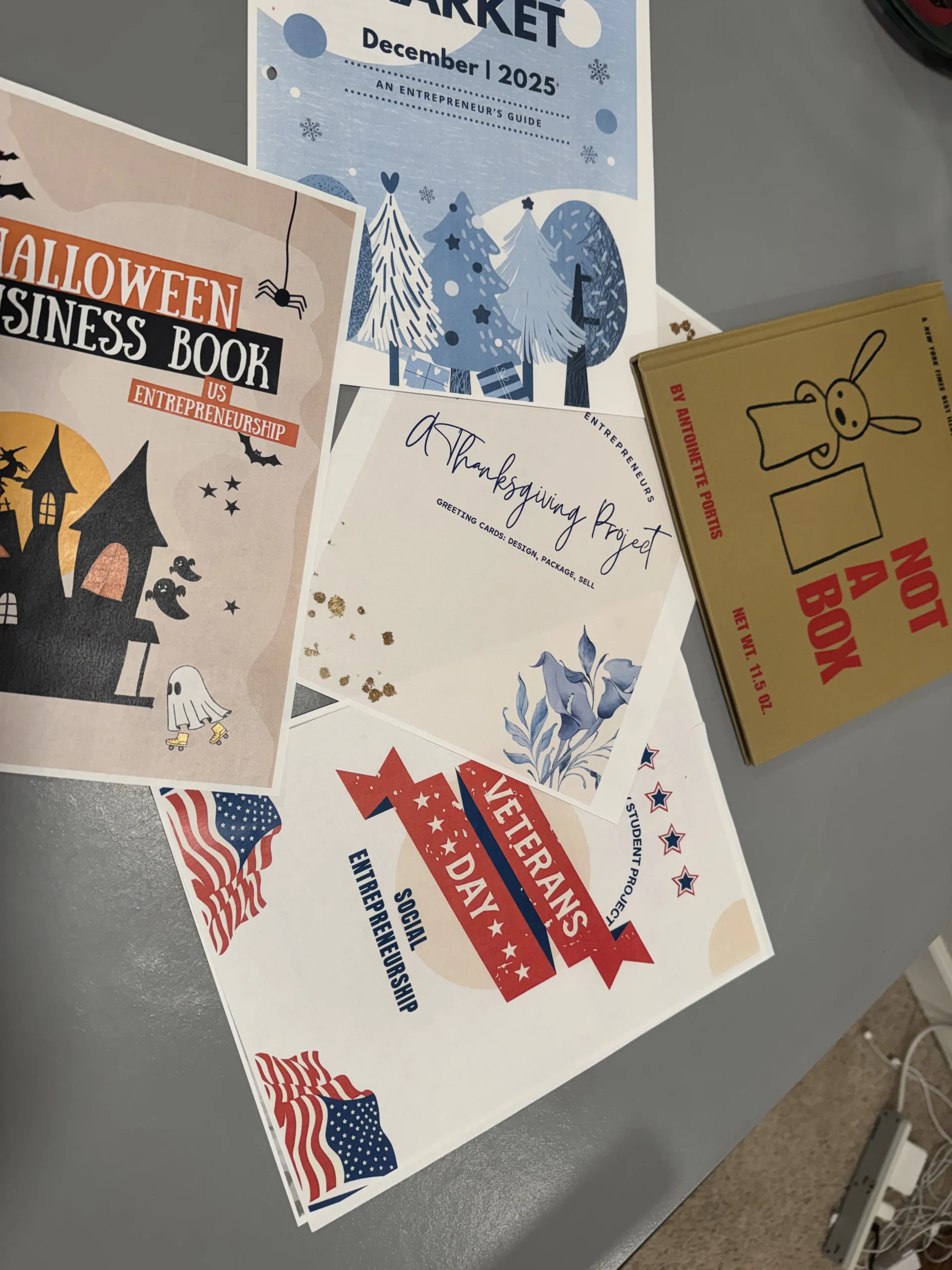
PBL Holiday Idea 2- Spirit Store Field Work: Seasonal Marketing for a Real Business
Halloween marketing is everywhere in October. This project sends students into it, then asks them to advise a local company.
Grade level:Grades 9–12
Driving Question:How do retailers use Halloween to drive sales, and how could a local business use those strategies in October?
Project Overview: Students study seasonal marketing, then do fieldwork at a Spirit store. They photograph displays, tally strategies, and analyze what is actually on the floor. Back in class, they write a proposal for a local business and pitch it. In this version, the audience was Spoons, a local smoothie company.
Subjects: Marketing, ELA, entrepreneurship, media.
Skills:
- Observational fieldwork and note-taking in a live retail setting
- Photo documentation of displays, signage, and product placement
- Tallying and categorizing marketing strategies
- Audience and offer analysis
- Proposal writing for a real client
- Oral pitching and handling questions
- Transfer: moving a tactic from a costume retailer to a different business
Optional AI Integration:
- Teachers: Use AI to build a fieldwork tally sheet before the visit.
- Students: AI can draft a first-pass outline. Students replace generic claims with photos, counts, and notes from the store.
Milestones & Scaffolding:
- Study seasonal marketing strategies before the visit.
- Fieldwork at the Spirit store.
- Sort which tactics transfer to a non-costume business.
- Draft and revise the proposal.
- Pitch to the partner business.
- Reflect on what the live store showed that a case study could not.
Final Products & Exhibition: Field notes and photo evidence, a written marketing proposal, and a live pitch.
Assessment & Reflection: Rubric on quality of evidence, fit of the strategy to the client, and clarity of the pitch.
Teacher Tips & Differentiation: Call the store ahead of time. Give a short capture list so the visit does not turn into browsing. Ninth and tenth graders can pitch in pairs. Eleventh and twelfth graders can own a full written proposal.
PBL Holiday Idea 3- Veterans Day: Social Entrepreneurship and Veteran-Owned Business
Veterans Day is more than a poster. This project treats it as a study of how people build businesses after service, and which supports exist to help them.
Grade level: Grades 8–12. Best in a high school entrepreneurship or civics course. Grade 8 works if the resource research is shortened.
Driving Question: How do veteran entrepreneurs build businesses that serve a community, and which resources make that path possible?
Project Overview: Students profile veteran-owned businesses, including product, target market, marketing, competition, and social impact. They research SBA Boots to Business, Veteran Business Outreach Centers, Service-Disabled Veteran-Owned Small Business certification, veteran-specific funding, and Bunker Labs. A guest speaker who owns a veteran business explains benefits he actually used. Students also watch a veteran-owned business on Shark Tank and analyze the investment decision.
Subjects: Entrepreneurship, social studies, ELA.
Skills:
- Business profiling from a structured rubric
- Identifying target market, competition, and one pro and one con
- Reading public programs and matching a scenario to the right resource
- Analyzing an investment decision from Shark Tank
- Listening to a guest speaker and connecting his story to the research
- Writing about social impact, not only profit
Optional AI Integration:
- Teachers: Use AI to assemble a resource list, then verify every link before students see it.
- Students: AI can suggest research questions. Students confirm answers on official SBA and VA pages.
Milestones & Scaffolding:
- Profile two veteran entrepreneurs.
- Research official resources and match scenarios to the best support.
- Guest speaker.
- Shark Tank analysis.
- Reflection on social impact.
Final Products & Exhibition: Completed profiles, a resource match, and a short brief on one veteran-owned business. A class share-out on Veterans Day works well.
Assessment & Reflection: Score the profile on business description, marketing, pros and cons, competition, social impact, research plan, loyalty, and the Shark Tank outcome.
Teacher Tips & Differentiation: Preview the episode. Send the guest speaker the student questions in advance. For grade 8, assign one entrepreneur and two resources instead of the full set.
PBL Holiday Idea 4- Not a Box Buddy Gifts: Design for a Real Kindergartner
Inspired by Antoinette Portis’s “Not a Box”, middle schoolers design a gift from a box for a kindergarten buddy. The constraint is the material. The brief comes from a child.
Grade level: Grades 6–8, partnered with kindergarten. Designers are middle school. End users are grade K.
Driving Question: How can we turn a box into a gift that fits what our kindergarten buddy actually loves?
Project Overview: Middle schoolers interview a kindergarten buddy, listen for interests, and design a gift using boxes and simple materials. Not every product is a game. Standout builds included a race-car ramp and a dollhouse.
Subjects: Design, ELA, SEL, science.
Skills:
- Interviewing a younger student and recording what they say
- User-centered design: building from evidence, not from a guess
- Prototyping with a materials constraint
- Basic spatial design and, for ramps, simple force and motion
- Iteration after a buddy test
- Oral explanation of design choices
- Empathy and cross-age collaboration
Optional AI Integration:
- Teachers: Use AI to draft interview questions appropriate for kindergarten.
- Students: AI can sketch a first concept. The build, the test with the buddy, and the revision stay human.
Milestones & Scaffolding:
- Read and discuss “Not a Box”.
- Buddy interview.
- Ideation under a materials constraint.
- Build and test with the buddy.
- Revise and gift.
- Reflect on what the interview changed.
Final Products & Exhibition: A finished gift and a short designer’s note. A buddy reveal is the exhibition.
Assessment & Reflection: Rubric on match to interview evidence, craftsmanship, and iteration. Reflection: what did you assume before the interview, and what did you change after?
Teacher Tips & Differentiation: Coordinate with the kindergarten teacher on time, allergies, and small parts. Offer a simple gift path and a build path so different skill levels both finish. Recycled boxes keep cost at zero.
PBL Holiday Idea 5: Thanksgiving Greeting Cards: From Canvas to Cricut
Students treat greeting cards as a small business, not a craft hour. They plan the company, make the product, and sell it before the holiday.
Grade level: Grades 7–10. Strong fit for middle school or a ninth- or tenth-grade entrepreneurship elective.
Driving Question: How can we design, package, and sell Thanksgiving greeting cards as a viable small business for our school community?
Project Overview: Students complete a simple business model canvas covering customer, value, channels, costs, and revenue. They design cards, produce them on a Cricut, package them, and sell to the school community.
Subjects: Entrepreneurship, design, math, ELA.
Skills:
- Completing a business model canvas
- Visual design and layout for a card
- Machine production on a Cricut, including file setup and a small production run
- Packaging and presentation
- Unit pricing that covers materials
- Customer communication and a short sales pitch
- Comparing what they planned to sell with what the school community actually bought
Optional AI Integration:
- Teachers: Use AI to generate sample canvas questions or a packaging checklist.
- Students: AI can draft card messages. Students edit for voice and audience before anything is cut.
Milestones & Scaffolding:
- Study who buys greeting cards and how they are packaged.
- Complete a business model canvas.
- Design and produce a small run.
- Price from materials.
- Sell to the school community.
- Compare projections with what sold.
Final Products & Exhibition: A business model canvas, a finished card line, packaging, and a school sale.
Assessment & Reflection: Rubric on canvas clarity, design quality, and whether the price covers cost. Reflection: what sold, what did not, and what they would change for the next holiday.
Teacher Tips & Differentiation: A Cricut helps but is not required. Hand-printed cards work. Limit the run so production does not swallow the unit. Sell in a short window before break. Seventh graders can use a partially filled canvas. Ninth and tenth graders can own costs and revenue on their own.
For more PBL resources visit craftedcurriculum.com.
About the Author: Jenny
